
In event planning, temporary team onboarding and preparing a training program, the laptops you choose quickly become far more than just equipment.
They influence how smoothly things run. They affect timing, coordination, and in many cases, how your team or audience experiences the work itself.
In these situations, the decision is typically framed as a simple one: laptop rental vs buying. Most businesses default to purchasing since it feels like the sensible, long-term option.
But that assumption doesn’t always hold. The right choice depends less on ownership and more on how, where, and how long the laptops will actually be used.
Key takeaways
- The laptop rental vs buying decision should be based on how long and where the devices will be used, not just upfront cost.
- Buying works best for stable teams with consistent, long-term needs and internal IT support.
- Renting is more practical for events, short-term projects, and situations where requirements can change quickly.
- Ownership often brings hidden challenges, including underused equipment, maintenance, and logistical complexity.
- Events require a different approach, where reliability, speed and readiness matter more than ownership.
- A simple framework, considering duration, flexibility, risk and internal capability, helps guide the right decision.
Why most businesses default to buying laptops
Buying laptops is the familiar route.
It offers a sense of control. The devices are owned, available at any time, and can be used across multiple projects. For stable teams and predictable workloads, this approach works well.
Procurement processes also tend to favour ownership. Budgets, approvals and asset tracking are often built around purchasing, so buying becomes the natural decision.
The challenge is that this mindset is often applied universally, even when the situation doesn’t suit it.
When needs become temporary, time-sensitive or variable, ownership can introduce more complexity than expected.

When buying laptops does make sense
There are clear cases where purchasing laptops is the right approach.
If your team uses the same devices every day, with consistent requirements and long-term demand, buying provides stability and control.
It typically works best when:
- Usage is ongoing and predictable
- Team size remains relatively stable
- Requirements are unlikely to change significantly
- There is an internal IT capability to manage setup, maintenance and updates
In these environments, laptops function as long-term assets. The investment is justified because the devices are continuously used and supported internally.
Where buying starts to create friction
Outside of those conditions, the limitations of buying tend to surface over time.
A common issue is underutilisation. Laptops purchased for a project, event, or expansion may sit unused once requirements shift.
Ownership also brings ongoing responsibility. Devices need to be configured, maintained, updated and occasionally repaired. What starts as a one-off purchase becomes a continuous operational task.
Logistics adds another layer. Managing devices across locations, storing unused equipment, and reallocating laptops between teams all require time and coordination.
There is also the question of longevity. A device that was suitable when purchased may not meet requirements a year later, particularly as software and workloads evolve.
These challenges are rarely immediate. They tend to appear when flexibility becomes more important than ownership.
When renting laptops becomes the more practical option
In more dynamic environments, renting often aligns with how businesses actually operate.
If laptops are only needed for a defined period, it makes sense to use them for that time and then return them. There is no need to carry unused equipment once the work is complete.
This becomes particularly relevant when evaluating laptop rental vs buying in situations such as:
- Short-term or project-based work
- Temporary staff or contractors
- Periods of rapid scaling
- Specialist tasks requiring higher-performance devices
- Teams working across multiple locations
In these cases, the advantage of laptop hire isn’t just cost. It is the ability to move quickly, adjust as needed, and avoid adding extra work for internal teams.
Events are a different category altogether
Events introduce a level of pressure that changes the decision entirely.
There’s very little room for things to go wrong. Equipment needs to work immediately, often in unfamiliar venues, with limited setup time and multiple moving parts.
A laptop used in a live event environment is expected to handle far more than everyday office tasks. It may need to connect to AV systems, support presentations, run software, and integrate with event platforms, all without interruption.
Small issues that might be manageable in an office setting become much more visible in a live environment.
That is why rental aligns more naturally with the requirement.
Devices can be prepared in advance, configured to the exact specifications needed, and delivered ready to use. If requirements change, quantities can be adjusted quickly.
For events, the priority isn’t ownership. It is more for the certainty. The equipment needs to work immediately and reliably, without adding pressure to the team delivering the event.

What businesses often overlook
When comparing laptop rental vs buying, it is easy to focus on the upfront cost. However, several practical factors are often underestimated.
These include:
- Devices sitting unused after projects or events
- Time spent maintaining, updating and troubleshooting equipment
- Internal effort required for setup and configuration
- Storage and logistics between uses
- The risk of selecting the wrong specifications
- The impact of last-minute changes
Individually, these may seem minor. In practice, they shape how efficiently a business can deploy technology when it matters most.
Laptop rental vs buying: a practical way to decide
Rather than treating laptop rental vs buying as a simple cost comparison, it is more useful to assess which approach fits your situation.
A simple framework can help guide that decision.
Duration of use
If laptops are needed for a short or defined period, rental is typically the more practical choice. For continuous, long-term use, buying may be more appropriate.
Variability of needs
Where requirements change regularly, rental provides flexibility. Stable, predictable needs are better suited to ownership.
Risk of failure
For high-stakes situations such as events or client-facing work, equipment failure is simply not an option. Renting reduces risk by ensuring devices are prepared, supported, and, importantly, recent.
Reliable rental companies maintain fleets of current, high-performance models. That means every time you have a project, your team gets the latest hardware, not equipment that has been sitting on a shelf for years. Businesses that purchase laptops naturally want to maximise that investment over time, but the longer those devices are in use, the more likely they are to slow down and fall behind evolving software demands. With rental, you sidestep that problem entirely. Each hire delivers consistent, up-to-date performance rather than ageing assets that may no longer be fit for purpose.
Internal capability
If internal resources are limited, rental removes the burden of setup and maintenance. Organisations with dedicated IT teams may prefer to manage owned devices.
Speed of deployment
When equipment is needed quickly, rental allows for faster delivery and setup. Buying typically involves longer procurement timelines.
Looking at the decision this way shifts the focus from cost alone to overall practicality.

Laptop rental vs leasing: a simple distinction
It is also useful to clarify how rental compares to leasing.
Rental provides short-term access with flexibility. Devices are used for a defined period and returned when no longer needed.
Leasing spreads the cost over a longer term with fixed agreements. It offers predictability but less flexibility.
Buying involves full ownership, along with responsibility for maintenance, upgrades and eventual replacement.
Each approach serves a different purpose, depending on how the equipment will be used.
Supporting your laptop deployment from start to finish
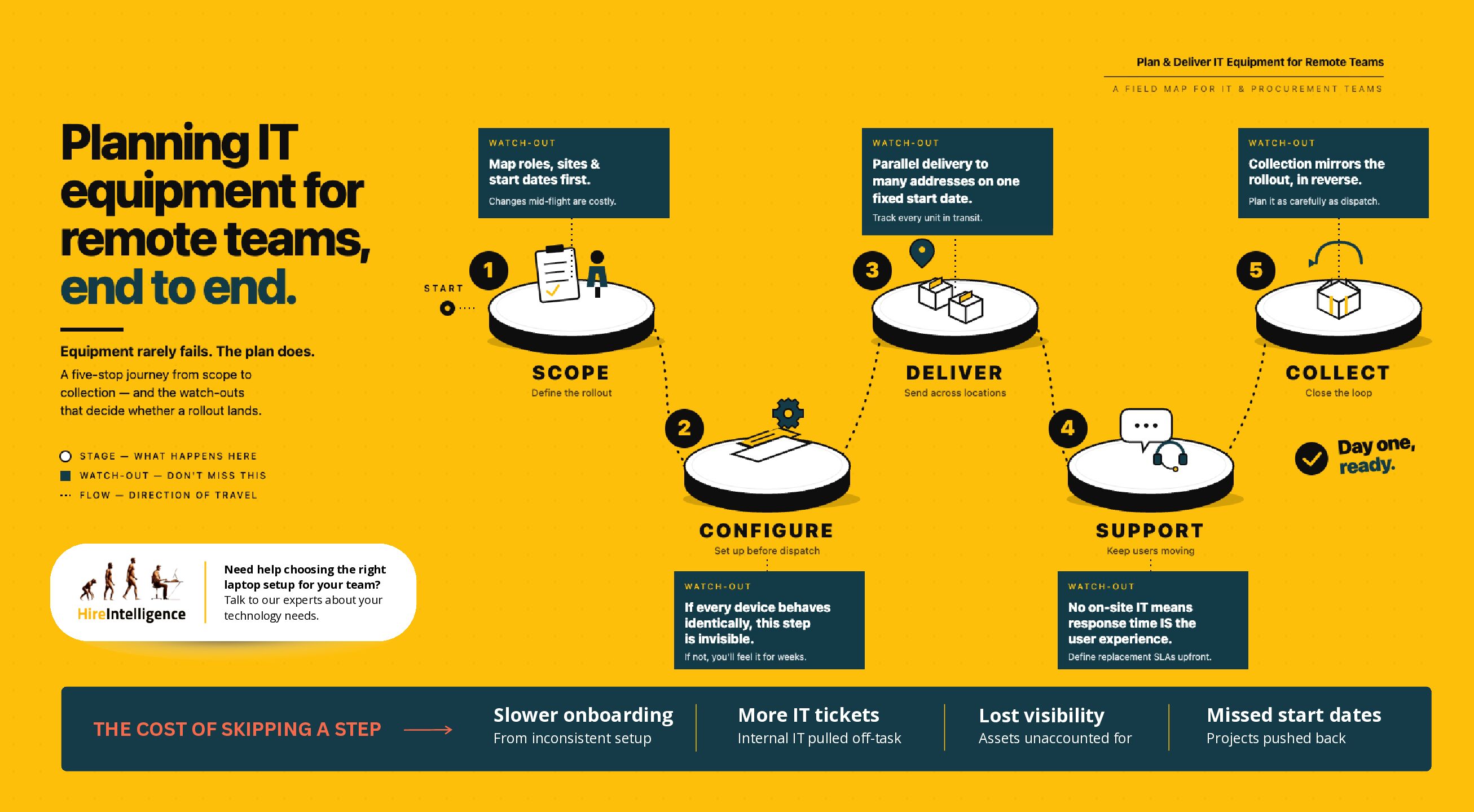
Short-term laptop requirements often come with tight timelines, multiple locations, and very little margin for error. Whether for an event, training programme or project rollout, the priority is getting everything in place without adding pressure to internal teams.
Hire Intelligence supports that process.
Rental periods are aligned to your timeframe, so you are only using the equipment for as long as you need it. Devices are prepared in advance to your specifications, helping ensure consistency and reducing setup time on site.
Delivery can be arranged to a single location or across multiple sites, depending on the structure of your project. Throughout the hire period, hardware support remains available, so your team can stay focused on delivery rather than troubleshooting.

Making the right choice for your business
There is no single answer to the laptop rental vs buying question.
Buying works well in stable environments where devices are used consistently over time. Renting becomes the more practical option when needs are temporary, time-sensitive or subject to change.
The key is understanding your context.
If you are planning an IT rollout, training programme or short-term project, taking a moment to assess laptop rental vs buying early on can make the process much smoother.
Speak with the Hire Intelligence team to discuss your requirements. We will recommend suitable devices, prepare them to your specifications, and arrange delivery to your office or venue so your team can get started without delay.
Frequently asked questions
Q. Can rented laptops be integrated into an existing IT environment?
A. Yes. Devices can be configured to align with your network, software requirements and security policies, making integration into existing systems more straightforward.
Q. Is it possible to standardise devices across multiple locations?
A. Yes. Consistent configuration can be applied across all devices, which is particularly useful for training programmes, multi-site deployments or events.
Q. How are laptops typically delivered and collected?
A. Delivery and collection can be arranged to suit your schedule and location, including offices, venues or multiple sites, depending on the scope of the project.
Q. How do you handle last-minute changes in quantity or requirements?
A. Adjustments can often be accommodated depending on availability, allowing you to scale up or refine specifications as plans evolve.
Q. How is consistency maintained across large volumes of devices?
A. Standardised configuration and preparation processes ensure devices perform uniformly across all users and locations.