
Buying IT equipment feels like the sensible, default choice. It’s familiar. Procurement processes are usually built around it.
But that assumption doesn’t always hold.
Renting IT equipment means paying for the use of hardware over an agreed period without owning it. Buying means paying upfront for outright ownership. So, is it better to rent or buy equipment for business in practice? For project work, events, seasonal demand or anything that needs to scale quickly, renting usually wins. The right call still depends on cash flow, how fast technology needs to change, and how much operational weight a business wants to carry.
Key takeaways
- Renting protects cash flow by turning a capital cost into a predictable operating expense.
- IT equipment loses roughly a quarter to a third of its value in year one, and that risk sits with whoever owns it.
- Buying carries real tax advantages through the Annual Investment Allowance, but it only pays off with long-term, stable use.
- Rental terms from one day to 24 months mean paying for exactly the time equipment is needed.
- A 20-minute quote and same-day delivery remove the procurement lag that comes with buying.
The financial case for renting
So, is it better to rent or buy equipment for business when the numbers are the real concern? The answer comes down to two core financial realities:
- Cash flow: Buying means capital outlay before the equipment has been used for a single day. Renting turns that spend into an operating expense, paid monthly and deductible against profit as incurred, rather than tied up in an asset on the balance sheet.
- Depreciation: IT hardware loses value fast. Laptops and similar equipment typically shed a quarter to a third of their value in the first year alone. That depreciation sits on the books whether the equipment gets used or not. With a rental, that risk sits with the provider instead.
Buying is not without its own tax advantages. The Annual Investment Allowance allows businesses to deduct up to £1 million of qualifying IT kit from taxable profits in the year of purchase, with a 40% First Year Allowance available from January 2026 once that limit is used up. Both are worth considering for long-term equipment, though neither addresses the upfront capital commitment that makes rental the more practical route for project-based or short-term requirements.
Staying current without a reinvestment cycle
IT hardware moves fast. The AI-chip laptops shipping now will look dated within two or three years, and MacBooks, tablets and AV kit follow a similar curve. Buy today’s spec, and the business is locked into it until the next capital cycle.
Rent it, and the fleet stays current. A rental provider refreshes its stock, so the equipment in use reflects what is available now rather than what was specified several years earlier.
Why fixed ownership creates problems for variable demand
Buying commits a business to an asset regardless of whether the need for it lasts a week or five years. Renting scales with actual demand.
Rental agreements scale to the actual requirement, so a two-week product launch gets exactly the equipment it needs, and nothing is left unused once the work is done. There’s no storage overhead, no asset register entry for equipment used twice a year, and no disposal headache when a project wraps.
Why procurement speed often decides the outcome
Bought equipment usually means a procurement cycle: sourcing, approvals, delivery lead times, and setup before anyone can use it. Renting compresses that timeline.
Hire Intelligence has been operating in the IT rental market for nearly 30 years, since 1996, and in the UK since 1997, supporting more than 20,000 customers over that time. Quotes turn around in 20 minutes, rental periods run from one day to 24 months, and same-day delivery is available for urgent requirements.
When a deployment cannot wait for a lengthy procurement process, that speed is the whole point.

When buying IT equipment is the right call
Renting is not always the right call, and it is worth being straight about that.
Buying works best when:
- Equipment is in constant, stable use over several years
- Volume and specification are unlikely to change
- The technology category moves slowly
- There is internal capacity to manage maintenance and disposal
A back-office server running the same workload for five years is a reasonable purchase. A fleet of laptops for a six-week event or a seasonal spike is a rental, almost always.
The service layer that changes the decision
Beyond the finance question, the real difference is the service wrapped around the equipment.
A Hire Intelligence rental includes asset tracking, secure data wiping on every returned device, hardware support if something needs attention, dedicated account management, and access to European distribution for businesses operating across borders. Renting also extends a device’s working life across multiple businesses rather than one, which matters for organisations with sustainability commitments.
That’s a different proposition to a straightforward procurement decision, and it’s the layer that matters most to consultancies, IT project firms and event companies considering everything from laptop rental vs buying through to full-scale fleet deployments.
Is it better to rent or buy equipment for business? A quick decision framework
Five factors tend to determine the right answer. Use this as a quick reference across each one.
| Factor | Points toward renting | Points toward buying |
| Duration | Project-based, seasonal or under 24 months | Constant, stable use over several years |
| Technology | Current-generation spec needed now; fast-moving category | Stable specification; slow technology cycle |
| Cash flow | Working capital is a constraint; OpEx treatment preferred | Capital investment is available; AIA and FYA reliefs apply |
| Volume | Headcount or demand likely to scale up or down | Requirements and team size unlikely to change |
| Administration | Asset tracking, data wiping and returns handled externally | In-house IT capacity to manage the full asset lifecycle |

Making the right call for your business
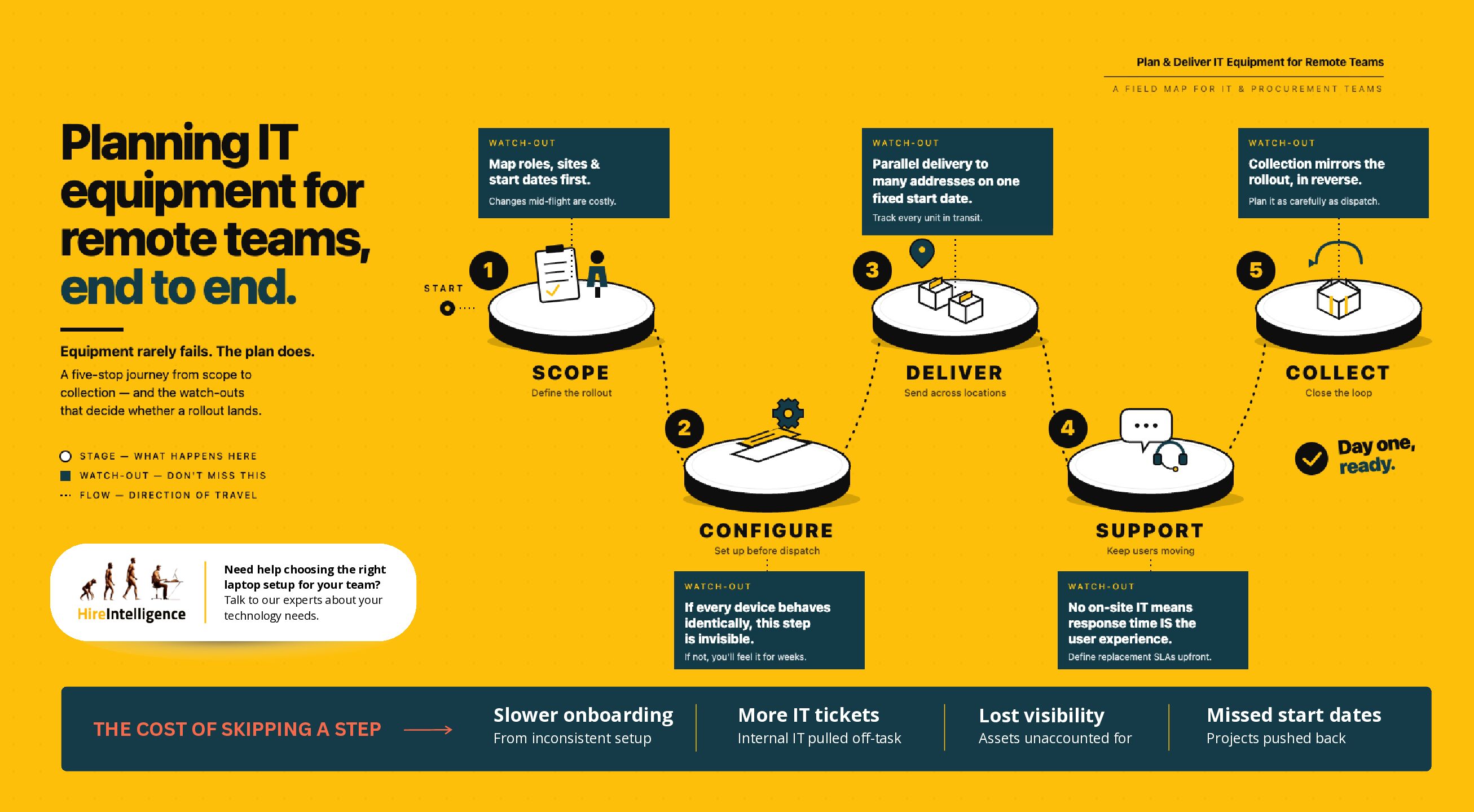
IT deployments are rarely forgiving. Equipment needs to arrive configured correctly, delivered on time and ready for use from the start.
Hire Intelligence handles that from end to end.
Devices are prepared to your specifications before dispatch and delivered to a single location or across multiple sites, depending on the project structure. Rental periods run from one day to 24 months.
If you are planning an IT rollout, event or short-term deployment, speak with the team today. We will confirm availability, advise on the right equipment and get everything in place exactly when it is needed.
Frequently asked questions
Is it cheaper to rent or buy IT equipment for business?
It depends on how long the equipment will be used. Renting avoids the upfront capital cost and depreciation risk, so it’s usually cheaper in the short term. Buying can work out cheaper over several years of constant use, especially once reliefs like the Annual Investment Allowance are factored in.
When should a business buy rather than rent IT equipment?
When the equipment will be in constant, stable use over several years, the volume and specification are unlikely to change, and the technology category moves slowly. A server running the same workload for five or more years, for example, is typically a stronger case for purchase than for rental.
Can you claim tax relief on rented IT equipment in the UK?
Rental payments are generally treated as an operating expense and deducted from taxable profit as incurred, rather than depreciated over several years the way a purchased asset would be.
What are the main benefits of renting IT equipment?
Protected cash flow, access to current-generation technology without a reinvestment cycle, flexible terms that scale with actual need, and a service layer covering asset tracking, data wiping and hardware support.
How quickly can rented IT equipment be delivered in the UK?
Hire Intelligence provides a quote within 20 minutes and offers same-day delivery for urgent requirements, with rental periods running from one day to 24 months.